Train Employees to Verify Risky Requests in the Age of AI Threats
AI is raising the stakes for everyday business security. Phishing, impersonation, credential theft, and social engineering are not new threats, but generative AI allows attackers to execute them faster, at greater scale, and with more convincing detail.
For small and midsize businesses, this means fraudulent requests are becoming harder to recognize. A payment change, password reset, or executive instruction may look legitimate, even when it’s part of an attack. Employees remain a critical line of defense, but they need practical verification habits that address today’s AI-enabled threats.
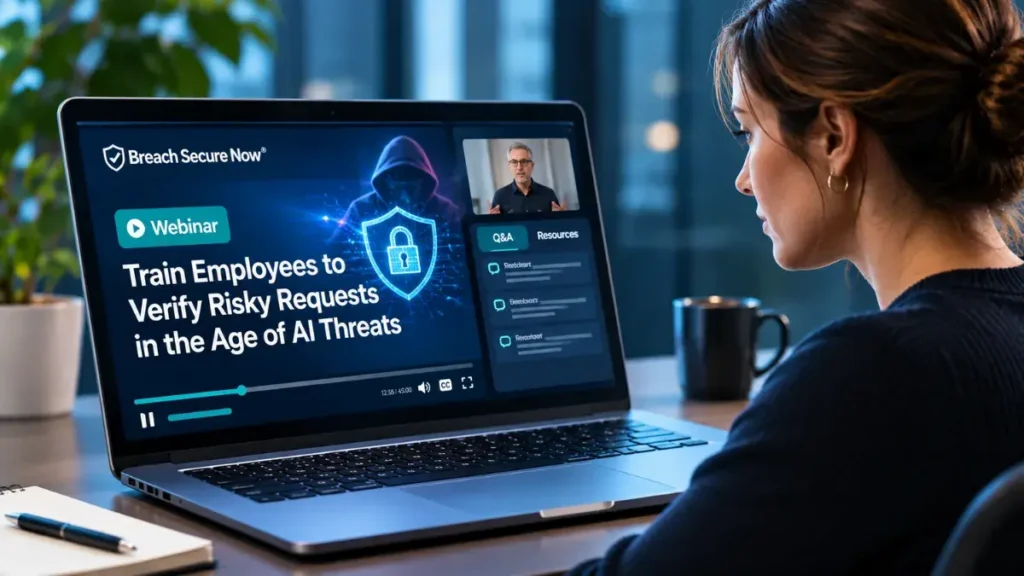
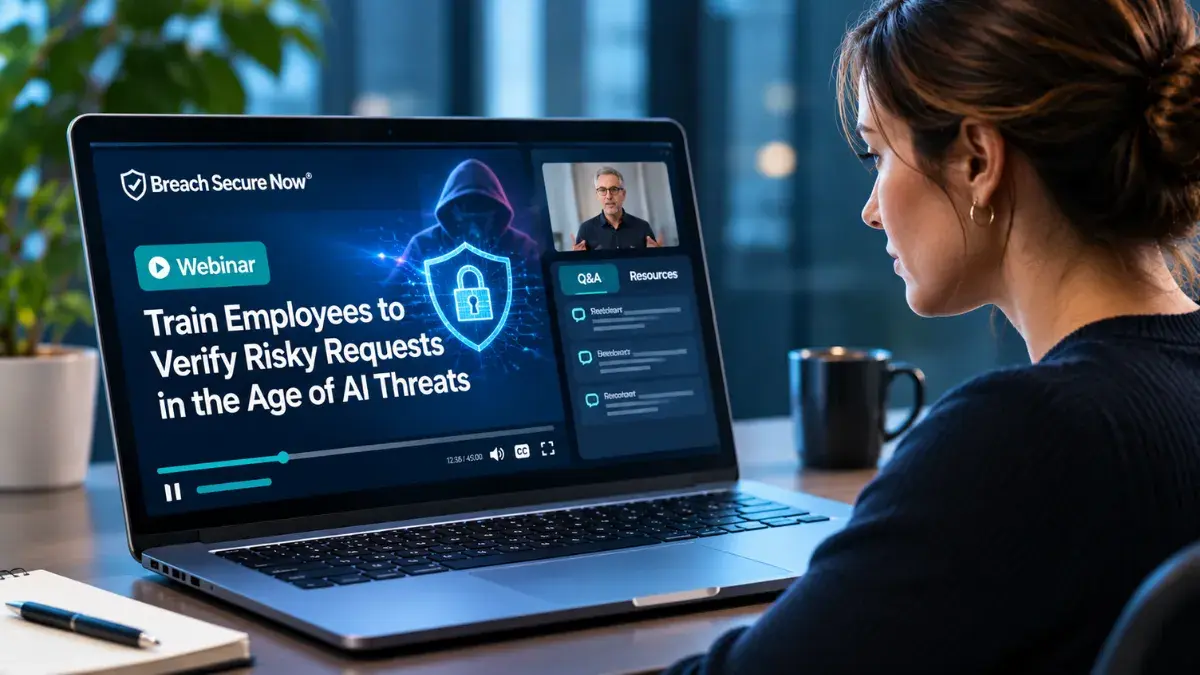
During a recent Breach Secure Now webinar, we explored how AI is changing cybersecurity threats and what businesses can do to strengthen employee awareness and protect sensitive information.
Watch the On-Demand Webinar Now
As AI tools become connected to email, file storage, customer records, and other business systems, they also introduce new security concerns. Many organizations already have employees using unapproved AI tools, often referred to as Shadow AI, without clear visibility into what information those tools can access.
Establishing clear AI governance policies and reinforcing employee education are essential steps toward adopting AI securely and productively.
Verify Risky Requests, Not Just Bad Emails
For years, employees were taught to identify phishing through misspellings, poor grammar, and suspicious formatting. While these warning signs still matter, AI can now generate polished, professional messages that convincingly imitate trusted contacts.
Employees must look beyond how a message appears and evaluate what it’s asking them to do. Does it request money, credentials, sensitive information, or changes to established procedures? Does it create unnecessary urgency?
Security awareness training needs to move from simply spotting suspicious emails to verifying risky requests.
The same principle applies to voice and video. AI-generated voice cloning and synthetic media can imitate executives, coworkers, and vendors, making impersonation attacks increasingly convincing.
When employees receive unusual requests involving payments, account access, or confidential information, they should verify them through a separate, trusted communication channel rather than responding directly.
Reporting suspicious activity is equally important. It allows security teams to investigate potential threats, warn other employees, and prevent similar attacks.
AI Account Security Risks
AI accounts, API keys, and connected applications are becoming valuable targets for cybercriminals because they can provide access to sensitive business information and workflows.
If an AI account is compromised, attackers may gain access to chat histories, uploaded documents, connected systems, or confidential customer information, depending on the permissions granted.
Another emerging threat is LLM jacking, where attackers use stolen API keys or cloud credentials to consume an organization’s AI services. Unauthorized usage can generate substantial costs before the business realizes its credentials have been compromised.
Personal AI accounts introduce additional concerns because they may operate outside an organization’s centralized security controls, including multifactor authentication, access monitoring, and usage restrictions.
Businesses should maintain visibility into which AI tools employees use, establish clear approval processes, and protect AI accounts through strong authentication, appropriate permissions, and monitoring for suspicious activity.
Prompt Injection and the Importance of Human Oversight
Prompt injection is another emerging security risk involving malicious instructions designed to manipulate how AI systems respond or behave.
These instructions may be entered directly into an AI tool or hidden within external content, such as documents, websites, or emails.
For example, an employee might ask an AI tool to summarize a document containing hidden instructions that manipulate the resulting summary. The employee could unknowingly rely on inaccurate or misleading information.
The risk becomes more serious when AI tools have permission to send emails, modify records, or perform other business actions.
Organizations should understand what information their AI tools can access and what actions they’re authorized to perform. Tools with greater permissions require stronger safeguards.
Human oversight remains essential, particularly for AI-assisted activities involving financial transactions, sensitive information, access permissions, or other significant business decisions.
Employees should also be trained to review AI-generated outputs, verify important information, and recognize when something appears suspicious or inconsistent.
Why Ongoing Employee Education Matters
AI is making phishing, impersonation, and social engineering attacks more convincing, but traditional cybersecurity fundamentals remain essential.
Employees need to understand that a professional-looking email, familiar-sounding voice, or confident AI-generated response isn’t necessarily trustworthy.
Employee education shouldn’t be a one-time event. Organizations need ongoing security awareness and AI training that reinforces foundational knowledge, introduces emerging threats, and helps employees apply what they’ve learned.
Short trainings, phishing simulations, and practical scenarios can strengthen employee awareness and reinforce safer decision-making.
As AI capabilities evolve, organizations must also update their policies and employee guidance to address new tools, integrations, and security risks.
Building a More Secure Approach to AI Adoption
AI offers meaningful opportunities to improve business productivity, but organizations need appropriate safeguards to manage the risks.
Businesses should identify where AI is already being used, establish clear policies, and limit access to sensitive information based on business needs.
Strong authentication, secure credential management, usage monitoring, and human approval for high-impact actions can help reduce exposure.
Employee education is equally important. Staff should understand how to recognize suspicious requests, verify information through trusted channels, and use AI tools securely.
AI may be changing how cybercriminals operate, but it doesn’t eliminate the value of established cybersecurity practices.
By combining technical safeguards, clear AI governance policies, and ongoing employee education, businesses can reduce risk while continuing to benefit from AI.
For MSPs, this creates an opportunity to help clients move beyond simply adopting AI tools and toward building the knowledge, safeguards, and confidence needed to use them securely and productively.