Passwords are one of the oldest parts of cybersecurity, but they remain one of the most important.
Even as businesses adopt advanced tools, AI-powered security platforms, endpoint protection, and cloud-based applications, a weak or reused password can still open the door to a serious breach.
That is why password security should not be treated as basic or outdated. It should be treated as a core part of modern cybersecurity awareness training.
Cybercriminals know that people often reuse passwords across multiple accounts. They also know that many passwords are based on familiar patterns: names, birthdays, pets, sports teams, seasons, or simple substitutions like “P@ssw0rd123.”
Once attackers obtain a username and password from one breach, they often test those same credentials across other accounts. This tactic, known as credential stuffing, works because too many people reuse the same login information across work and personal platforms.
That means one compromised account can quickly become the starting point for a much larger attack.
Strong Passwords Still Matter
A strong password is long, unique, and difficult to guess. Length and unpredictability are two of the most important factors in password strength, which is why passphrases are often more secure and easier to remember than short, complex passwords.
For example, a phrase made up of several unrelated words is usually easier for a person to remember and harder for an attacker to crack than a short password with predictable character swaps.
Employees should avoid:
- Reusing passwords across accounts
- Saving passwords in spreadsheets or notes apps
- Using personal information in passwords
- Sharing passwords with coworkers
- Making minor changes to old passwords
- Using the same password for work and personal accounts
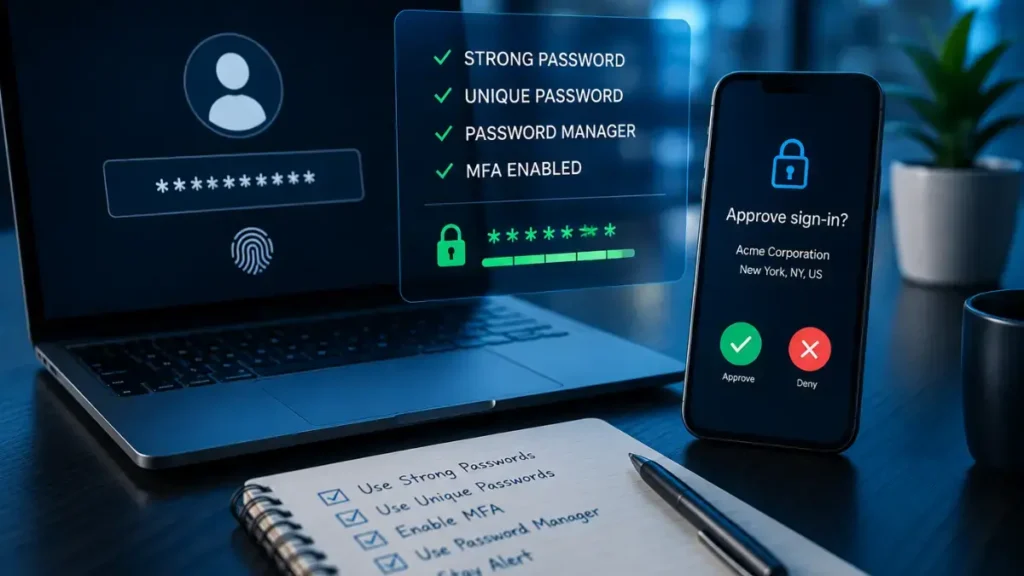
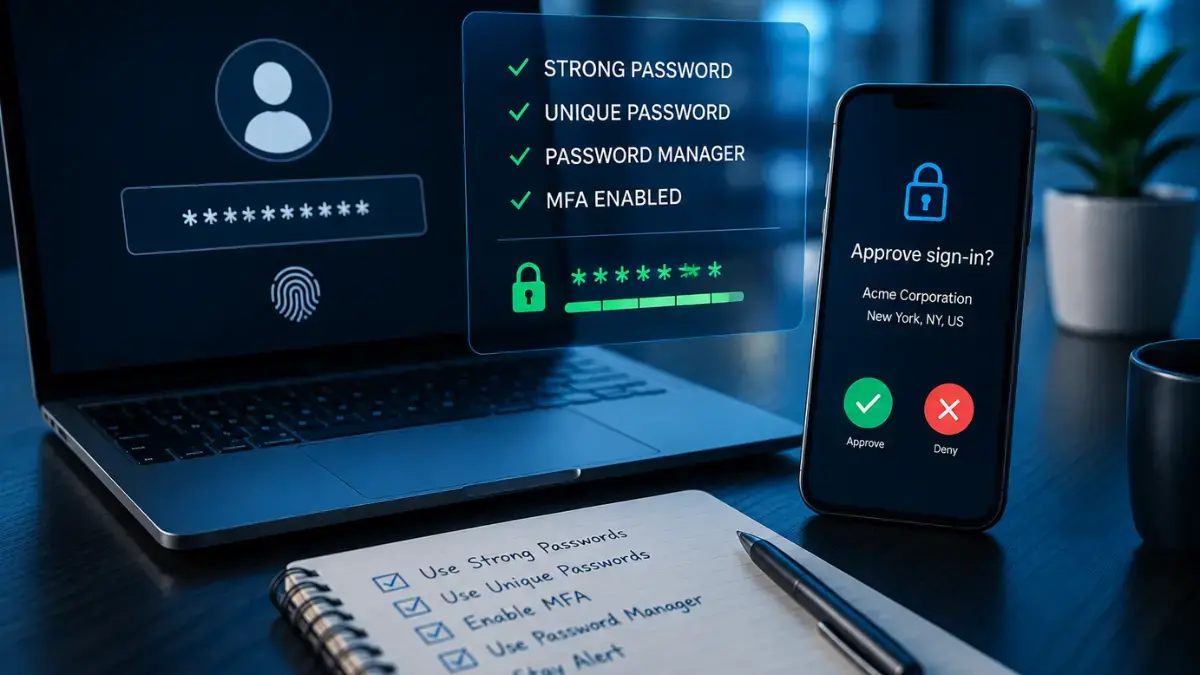
A Password Manager can help solve one of the biggest challenges employees face: remembering unique credentials for every account. Password Managers store credentials in an encrypted vault and help users generate stronger passwords without needing to memorize each one.
MFA Adds a Critical Layer of Protection
Strong passwords are important, but they are not enough on their own.
Multi-factor authentication, or MFA, adds another layer of protection by requiring users to verify their identity with more than just a password. This may include an authentication app, a physical security key, biometrics, or another approved verification method.
Research involving Microsoft Azure Active Directory users found that MFA reduced the risk of account compromise by 99.22% across the full population studied and by 98.56% in cases involving leaked credentials. (arXiv)
That is a powerful reminder: MFA works.
However, employees still need training. Attackers are increasingly using phishing tactics designed to trick users into approving MFA prompts, sharing one-time codes, or authorizing fraudulent login requests. Recent reporting has also highlighted phishing kits that attempt to bypass MFA by abusing legitimate login flows and stealing access tokens.
In other words, MFA is essential, but users must understand how to use it safely.
Employees should be trained to:
- Never approve an MFA prompt they did not initiate
- Avoid sharing one-time codes with anyone
- Report unexpected login alerts immediately
- Use app-based MFA or security keys where possible
- Treat MFA fatigue attempts as suspicious
- Understand that IT should never ask for their password or MFA code
Password Security Is a Human Behavior Issue
Password protection is not just an IT policy. It is an everyday employee habit.
That is why cybersecurity awareness training matters. Employees need to understand how attackers use stolen credentials, why password reuse is risky, and how MFA helps protect both personal and business accounts.
For MSPs, this creates an important opportunity to help clients improve one of the most fundamental areas of cybersecurity. Password hygiene, MFA adoption, and credential protection should be part of every client’s broader security awareness strategy.
At Breach Secure Now, we help MSPs educate employees on the behaviors that reduce risk. That includes building stronger password habits, recognizing credential theft attempts, using MFA properly, and understanding how small decisions can prevent larger security incidents.
Because the reality is simple: attackers do not always need to break in. Sometimes, they just need someone’s password.
Build Better Habits Before a Breach Happens
Cybersecurity is strongest when employees understand their role in protecting the organization.
Better password habits and proper MFA use are simple, practical steps that can significantly reduce risk. But they only work when employees know what to do and why it matters.
Do not reduce, reuse, or recycle passwords.
Create unique credentials. Use a password manager. Enable MFA. Pause before approving login requests. Report anything suspicious.
These may seem like small actions, but together they form a stronger human firewall.
And in today’s threat landscape, that human firewall matters more than ever.