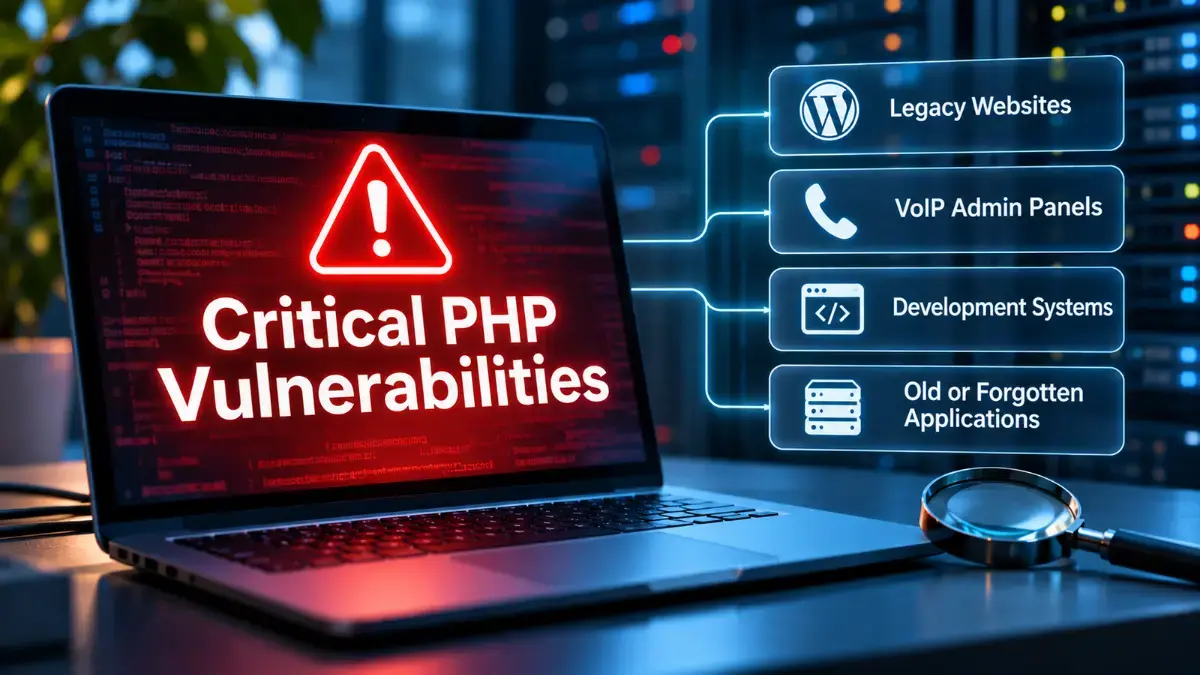
Two critical PHP vulnerabilities are exposing a familiar cybersecurity challenge: businesses cannot protect systems they don’t know they have.
Imagine asking a business owner whether their organization uses PHP.
Chances are, the answer would be no.
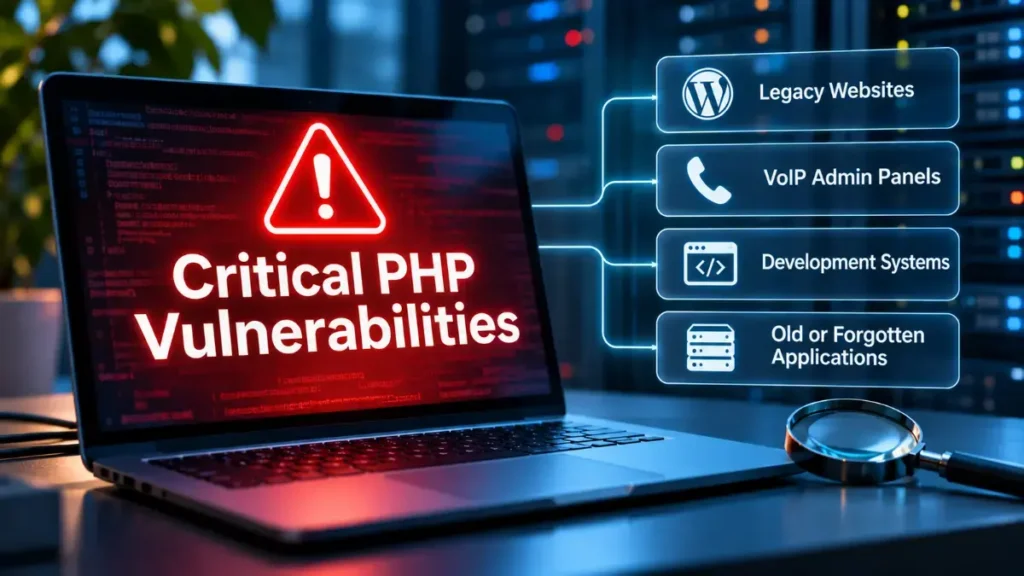
But what about the company’s website? Its phone system’s administrative portal? An old application built by a contractor? Or the server that hasn’t been updated since the last office expansion?
That’s where the answer gets more complicated.
In October 2026, cybersecurity researchers disclosed two critical vulnerabilities in PHP, a programming language widely used to power websites, applications, and administrative interfaces.
The vulnerabilities, collectively known as PHP2Shell, serve as an important reminder that cybersecurity risks aren’t always hiding in the technologies businesses use every day.
Sometimes, they’re hiding in the systems everyone has forgotten about.
What Happened with PHP2Shell?
On October 21, 2026, security updates were released to address two critical PHP vulnerabilities, identified as CVE-2026-109618 and CVE-2026-109619.
Both vulnerabilities could allow attackers to execute malicious code remotely on affected systems without needing valid login credentials.
That creates potentially serious consequences for organizations operating vulnerable PHP installations, including unauthorized access, data exposure, and the possibility of further compromise.
Even more concerning, attackers were already looking for opportunities before the patches became publicly available.
Amazon Threat Intelligence identified an attempted exploitation dating back to October 17, four days before the security updates were released.
The Cybersecurity and Infrastructure Security Agency (CISA) subsequently added both vulnerabilities to its Known Exploited Vulnerabilities catalog, reinforcing the need for organizations to prioritize remediation.
For businesses and their IT providers, the message is clear: identifying and addressing vulnerable systems should be an immediate priority.
The Bigger Problem: Technology Nobody Remembers
One of the most important lessons from PHP2Shell has little to do with PHP itself.
It has to do with visibility.
Businesses accumulate technology over time. Websites get redesigned. Employees introduce new tools. Vendors install applications. Contractors build internal portals. Older systems continue operating because replacing them never becomes an immediate priority.
Eventually, organizations may lose track of what’s running behind the scenes.
Consider a few examples:
- An older WordPress website that remains accessible after a company rebrand.
- A self-hosted phone system with a web-based administrative interface.
- A development environment that was never disconnected.
- A network storage or backup management console.
- An internal application created by a former employee or contractor.
- A legacy business portal that still handles sensitive information.
These are examples of systems worth reviewing, not a list of products confirmed to be vulnerable to PHP2Shell. Actual exposure depends on the PHP version, configuration, and applicable vendor updates.
The problem is that businesses may not know these systems exist, let alone whether they’re receiving security updates.
Research from Qualys illustrates the scale of the challenge. Its October 2026 analysis found that 71% of PHP installations with identifiable versions in its customer telemetry were running end-of-life or end-of-support releases.
When software is no longer supported, organizations may be left without a straightforward way to address newly discovered vulnerabilities.
And when an outdated system is missing from an organization’s asset inventory, it may never make it onto the patching schedule.
Why Patching Alone Isn’t Enough
Installing security updates is an essential part of cybersecurity, but effective vulnerability management starts before a patch is available.
Organizations need to know which systems they operate, which software versions those systems use, and who is responsible for maintaining them.
In the case of PHP2Shell, that means identifying affected installations, verifying the appropriate vendor fixes, and updating or isolating vulnerable systems as quickly as possible.
It also means considering whether a system could have been compromised before it was patched.
A software update can address a vulnerability, but it does not automatically remove an attacker who may have already gained access.
That’s why organizations should work with their IT or security provider to review relevant activity, investigate suspicious behavior, and determine whether additional remediation is necessary.
The larger lesson applies well beyond PHP2Shell.
A patch can close a security gap. An effective cybersecurity program helps organizations find those gaps before attackers do.
What Businesses and MSPs Should Do Next
PHP2Shell provides a timely opportunity for businesses and MSPs to review some fundamental cybersecurity practices.
- Identify overlooked systems. Review websites, administrative portals, development environments, legacy applications, and other technology that may fall outside normal maintenance processes.
- Verify software support and updates. Determine whether affected systems are running supported software and whether the appropriate security updates have been applied. Systems that cannot be patched may need to be isolated, replaced, or retired.
- Review potential signs of compromise. Because exploitation attempts began before public disclosure, organizations should evaluate relevant system activity rather than assuming that installing an update resolves every concern.
- Revisit cybersecurity risk assessments. A comprehensive assessment can help identify outdated technology, overlooked assets, and gaps in an organization’s security practices.
- Strengthen employee awareness. Employees should understand why unapproved applications, abandoned tools, and unexpected system behavior deserve attention. They should also know how to report concerns to the appropriate IT or security team.
Not every employee needs to understand PHP vulnerabilities.
But everyone can contribute to a workplace where security risks are identified, communicated, and addressed before they become larger problems.
Cybersecurity Requires More Than Responding to the Latest Threat
For MSPs, incidents like PHP2Shell create an opportunity to have more meaningful conversations with clients.
Instead of focusing exclusively on the latest vulnerability, ask broader questions:
Do we know what systems are operating across the business? Are those systems still supported? Who is responsible for keeping them updated? What happens when a vulnerability is discovered in technology we didn’t know existed?
These conversations help move cybersecurity beyond reactive troubleshooting and toward ongoing risk management.
At Breach Secure Now, we believe cybersecurity is strengthened when organizations combine technical safeguards with continuous employee education and awareness.
Security Risk Assessments help organizations better understand their exposure, while cybersecurity awareness training helps employees recognize potential threats, make safer decisions, and contribute to a stronger security culture.
Technology and people both play important roles in reducing risk.
Don’t Wait for the Next Vulnerability to Find What’s Missing
PHP2Shell may eventually fade from the headlines, but the underlying challenge isn’t going away.
Businesses will continue introducing new applications, adopting emerging technologies, and relying on systems that gradually become outdated.
The organizations best prepared for future threats will be those that understand what technology they have, maintain it appropriately, and establish a culture where cybersecurity remains an ongoing priority.
Because the next serious vulnerability may not be hiding in a new system. It may be waiting in one your organization forgot was there.