You already have the data. The hard part is getting to it fast enough to do something with it.
Almost every MSP I talk to has some version of the same routine. Log into the portal. Open a client. Pull a report. Download it. Open the next client. Repeat. One partner described their current process to me as “downloading everything, and throwing it into a folder.” By the time the folder is full, the QBR is tomorrow.
That’s the problem the Breach Secure Now MCP was built to solve. (If you missed it, start with our introduction to the Breach Secure Now MCP.) This post goes a level deeper: what MSPs are actually doing with it, and why it changes how you work with your BSN Portal data.
Your Data Should Come to You
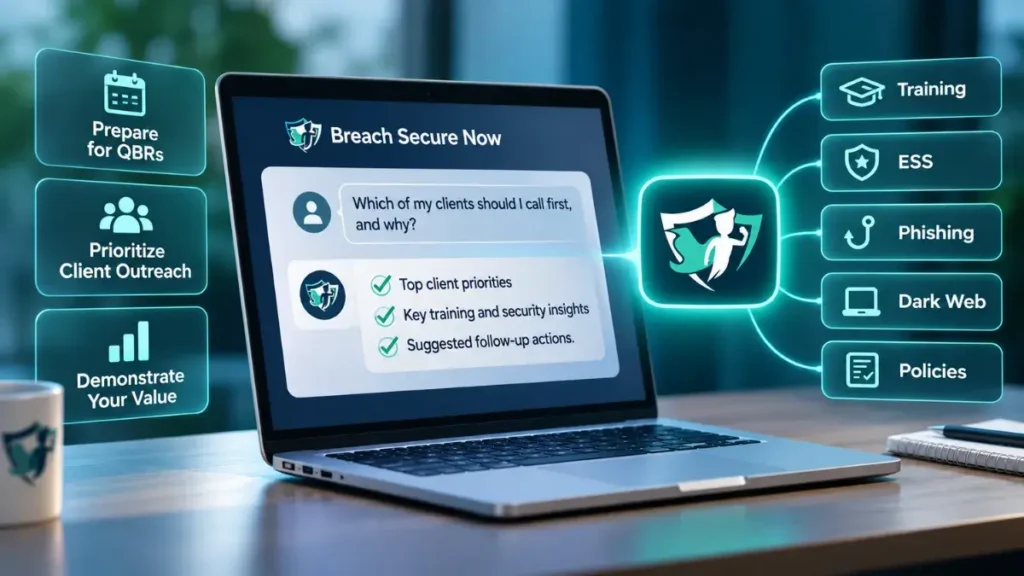
The BSN Portal holds a lot of useful signal about your clients: Employee Secure Score (ESS), training completion, phishing failure rates, dark-web exposure and policy acknowledgment.
The data has always been there. The trouble is that the insight you need is spread across clients, screens and reports, and someone on your team has to assemble it by hand.
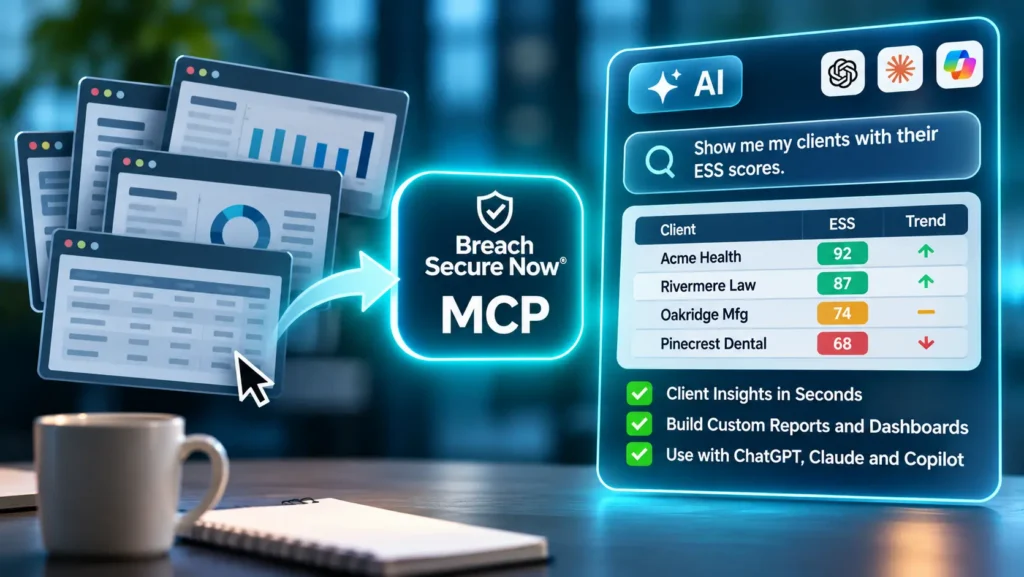
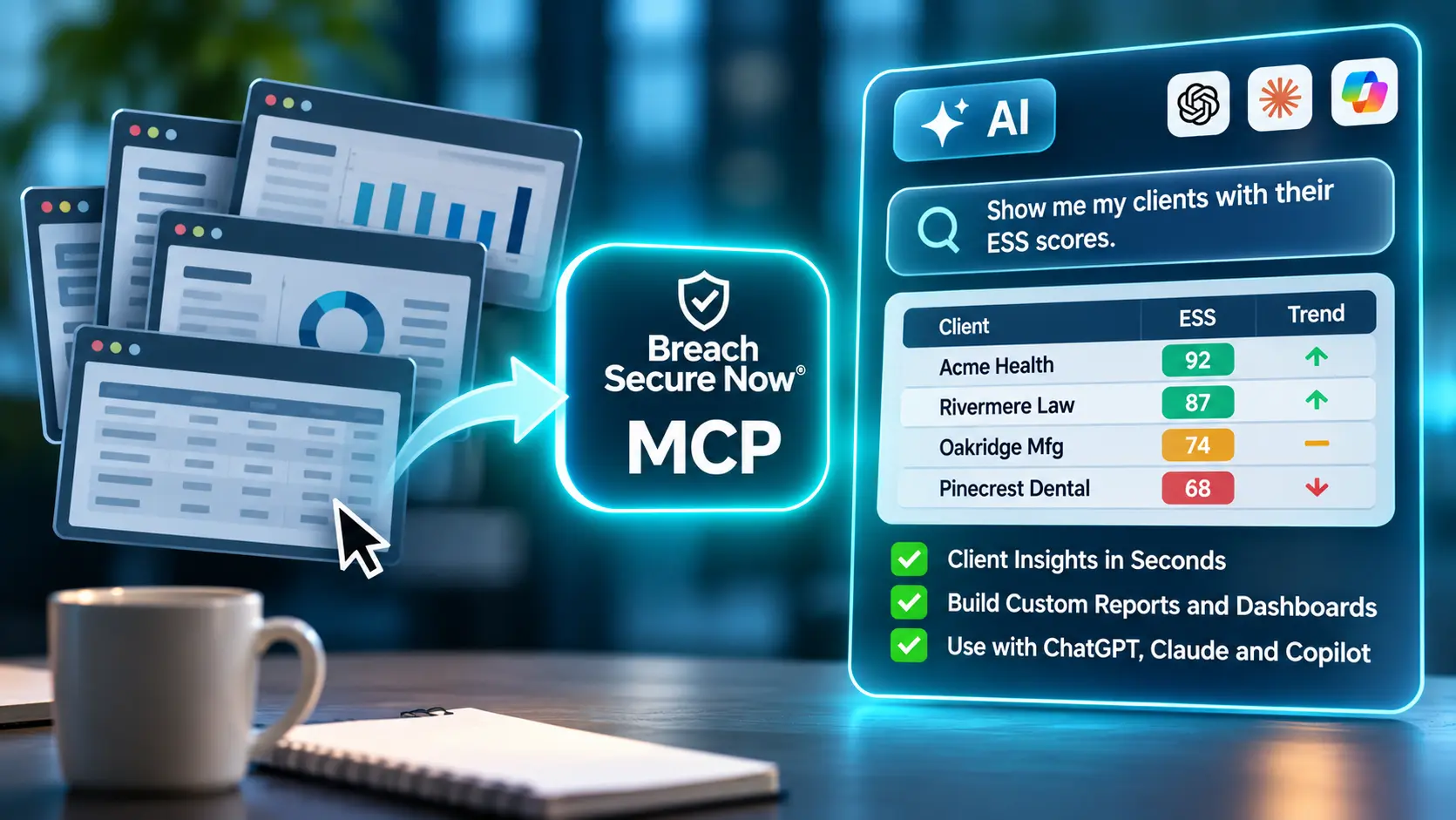
With the MCP connected, you skip the assembly. You ask a question in ChatGPT, Claude or Microsoft Copilot and get an answer drawn straight from your portal data:
- “Give me a list of my clients and their ESS scores.”
- “Which client has the lowest ESS score, and which users are pulling it down?”
- “Show me the 10 riskiest users at [client].”
- “Which of my clients have the most unacknowledged policies?”
A customer success manager at one of our partner MSPs summed it up after seeing it for the first time: “It just makes it so much easier when you can just ask it questions.” One conversation covers every client, with no separate login-and-click routine for each one.
This matters most for the people on your team who aren’t technical. One partner’s AI lead told us his goal was for their vCIO team, who are non-technical, to “easily query the portal” for things like who failed a phishing test. They walk into the client meeting prepared, and no technician gets pulled off the board to run a report.
Build the Report You’ve Always Asked Us For
Here’s a confession. For years, partners have asked us for specific changes to our reporting. Add this field. Hide that one. Put this metric next to that one. Use our logo. Break it out by department.
Those are good requests, and we couldn’t say yes to all of them. A report built for thousands of MSPs can only flex so far.
The MCP changes that math. Your portal data is now available inside the AI tools you already use, so you can build your own reporting and dashboards exactly the way you want them. For example:
- A branded client report with only the metrics that client cares about
- An executive one-pager that leads with the ESS trend and leaves the detail for later
- A high-risk user list for your account manager, sorted the way they work
- A dashboard across all your clients that refreshes on a schedule
You get the data. You decide what the report looks like.
A compliance lead at one partner challenged us on this, and her question was fair: “We already have this information available in a report… what does the MCP do?” Then she watched a live demo. Her takeaway: “the report can only give you so much.”
One Place for the Whole Picture
Most MSPs we work with aren’t asking AI about BSN data in isolation. They want the whole client picture.
One partner has built an internal data warehouse that pulls in their PSA, RMM, Microsoft 365, EDR and application-control data, with their own MCP connection on top so the team can query all of it in Claude or ChatGPT. Another connects vendor MCPs to Copilot Studio agents that build a “current state of IT” one-pager for anyone walking into a client.
BSN Portal data slots right into setups like these. The human side of security (who’s trained, who’s clicking, who’s at risk) now sits next to your endpoint, identity and ticket data in the same conversation. And the more relevant data the AI can see, the sharper the insight it gives you back.
Why an MCP and Not Just an API?
Some partners already pull BSN data through our API, and that works well. An API is something you build against, though. When we add new data or change an endpoint, you have to update your integration to use it.
An MCP works differently. Model Context Protocol is an open standard supported by ChatGPT, Claude and Microsoft Copilot. When you connect the Breach Secure Now MCP, your AI assistant asks it what it can do. The MCP replies with a list of tools, each with a plain-language description of the data it returns and the details it needs, like a client name. When you ask a question, the AI picks the right tool, requests the data and uses the response to write its answer. Because the AI learns what’s available from the MCP itself, there’s nothing to hard-code. When we add new data, it appears in the connection you already have.
And we are adding data. More detail on training and phishing activity is on the roadmap, and it will appear in that same connection when it ships.
Built for How MSPs Work
Before you connect anything to an AI tool, you should ask what it can reach. Partners have asked us exactly that, and here’s the short answer:
- Read-only. The MCP retrieves data. It doesn’t change training records, launch campaigns or modify settings.
- Your permissions, nothing more. You sign in with your BSN credentials and see only what you could already see in the portal.
- Your AI tool of choice. ChatGPT, Claude and Microsoft Copilot are all supported.
Ask Instead of Dig
You shouldn’t have to dig through dashboards to figure out which client needs a call this week. That answer already lives in your BSN Portal. The MCP gets it to you, and to the AI agents you build, in seconds, shaped however you want.
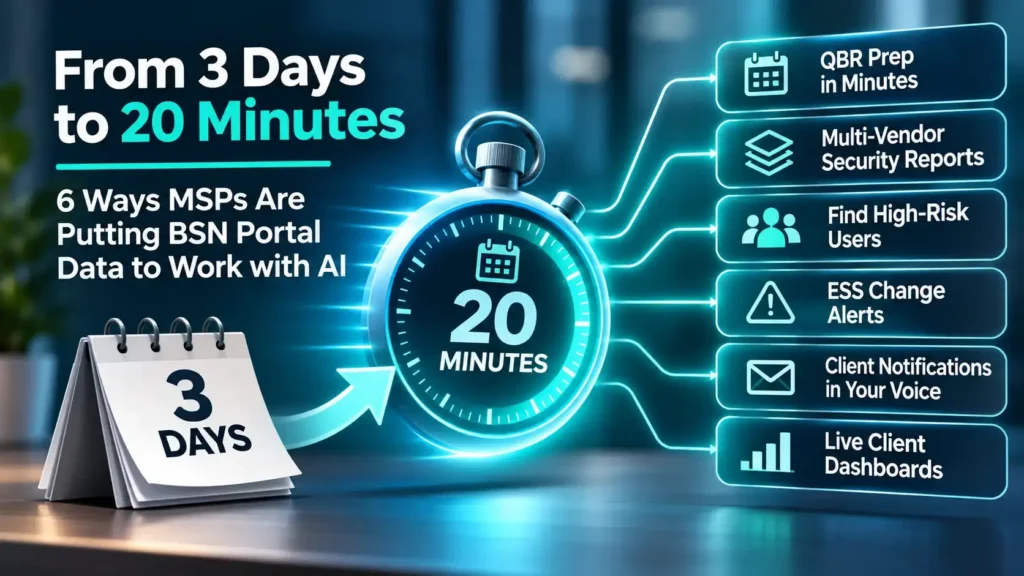
Next up: six specific ways MSPs are putting BSN Portal data to work, from QBR prep to Monday-morning risk reports.
Connect the Breach Secure Now MCP
Need help getting connected? Reach out to your Breach Secure Now Partner Success Manager.